

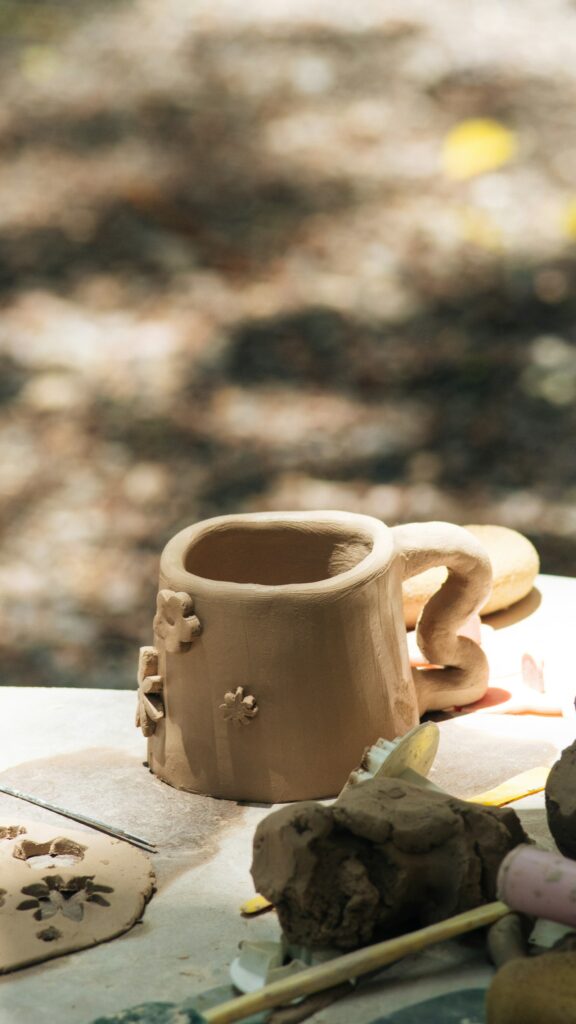
On my shelves right now there’s a lumpy mug from a pottery class that leans slightly to the left, as if it’s listening for something, and a scarf with one dropped stitch that I now describe as “a design choice.” There’s also a collage that took my entire Saturday and is currently taped to the refrigerator, where it’s admired by exactly one person (me) and one dog (Charlie, who mostly admires the refrigerator). Things made by hand come out crooked, imperfect and completely yours, and I wouldn’t trade a single one of mine.
The pressure to be good at everything
Somewhere along the way, a lot of us stopped making things unless we were good at them. If we take up painting, we feel like we should post it, and if we learn to knit, someone immediately asks if we’ve thought about opening a shop. Every hobby becomes a side hustle, and every side hustle becomes one more source of stress. (I say this as an entrepreneur who has absolutely tried to monetize a hobby or two, so I’m preaching to myself here, too.)
So I’d like to propose a radical alternative: make something useless, badly, just for the fun of it.
The benefits of making things with your hands
It quiets your brain. When my hands are busy, my mind finally slows down. Rolling clay, cutting paper and pulling thread through fabric all come close to meditation, without the part where you have to sit still and not think about lunch. There’s a reason so many people picked up crafts during stressful times, because repetitive handwork really can help calm an anxious mind (and my ADHD brain loves having somewhere to put all that restless energy).
It teaches patience. You cannot rush a glaze, speed up drying paint or skip ahead in a knitting pattern, so making things by hand forces me to wait, which has not historically been my strongest skill.
It makes mistakes feel survivable. A crooked line in a drawing isn’t a crisis, it’s just a line, and that lesson sneaks into the rest of your life in good ways. The first time a big writing deadline went sideways after I’d taken up pottery, I caught myself thinking, “Well, it’s a lumpy mug, but it still holds coffee.” And it did!
It connects you to the women before you. My grandmother sewed, and my aunt crochets everything, including, once, a cover for a toaster. When I make something with my hands, I feel connected to a long line of women who made beautiful, useful things out of whatever they had, and that matters to me more than I can say.
Easy handmade projects to try as a beginner
Pottery. A beginner class at a local studio is the best place to start. Your first bowl will be lopsided, so use it every day anyway.
Collage. All you need is old magazines, scissors, a glue stick and a piece of cardboard. It requires no skills at all, it’s endlessly satisfying, and it’s a great use for the catalogs you never asked for.
Embroidery. It’s cheap, portable and calming, and all you need is a hoop, a needle and a few colors of thread. I learned by ignoring all the rules first, and I highly recommend it.
Watercolor. Grab a small travel set and a pad of paper and paint whatever is in front of you. Your coffee cup counts, and so does your dog, if your dog will cooperate (mine will not).
Bookbinding. Making a small handmade notebook is surprisingly simple and deeply satisfying, and once you make one, you’ll want to make ten.
Bread. Yes, baking counts! Kneading dough is making by hand at its most ancient, and you get to eat the results.
Machines make perfect things. People make things with stories in them.
How to make time for making
Treat it like a date with yourself. Block off a Saturday afternoon, put your phone in another room and set up a little station on the kitchen table. Make some tea, put on music, and don’t plan what you’re making too carefully, so it has room to surprise you.
When you finish, try not to judge it. Put it somewhere you’ll see it every day, like the fridge, a shelf or your nightstand, and let it be crooked. Handmade things carry evidence of the person who made them, whether that’s a thumbprint in the clay, an uneven hem or a brushstroke that went a little too far, and that’s exactly what makes them precious.
And if you need permission to make something that will never be sold, posted or perfect, here’s how I spent a Saturday doing exactly that. Go make something lumpy this weekend, delighters, because you’ll be surprised how much you love it.
Did this one delight you? Tap the heart.
Did this one stay with you? I’d love to hear what you think.
Join the conversation (2 thoughts)



2 thoughts on “Why Making Things by Hand Is Good for You, Even When They Come Out Crooked”
Show me your crooked, wonderful, handmade things! My first attempts at almost everything looked terrible, and I love them anyway.
We have to stop expecting everything we make to look like it came from a shop.