

It was Cousin Minny’s turn to host the fish fry after church. She told me she’d made a special batch of lemonade just for me and promised it would be waiting in the icebox, still cold.
I’d never been more grateful that our beat-up Buick’s windows didn’t go up. I leaned my head out, showing no care for the curls the humidity had already begun to steal. The wind was no match for the heat shimmering beyond the windshield, though. You could see hotness rising off the street in waves, making the road look like it was becoming one with the earth.
Some blamed The Dice brothers for the hell we experienced that summer. Big Mama said they’d been carrying on too much down at the pool hall and that one of the brothers, Ray, I think it was, had lost all the money his wife saved to send their youngest to school. “It’s no wonder the devil ain’t come to snatch them up sooner! They turnin’ Shreveport into Babylon!” she’d said.
It scared me when Big Mama talked like that. Momma said it was foolishness, but I knew… we all knew that there was no other reason for our town to be a furnace that summer. The heat was smothering, oppressive – and the sun shone bright like to bleach away every bit of black.
My thighs stuck to the hot vinyl of the backseat, and I looked at my momma, whose face was gray with exhaustion from three jobs and no sleep. “It’s hot as hell, ain’t it?” I said. I liked to test my cursing abilities when I knew that Momma didn’t have enough salt left in her veins to fuel a whooping. She just nodded, her hands clinging to the wheel, the sullen Shreveport air whipping her face.
As the Buick rattled toward Cousin Minny’s house, we passed a big oak tree with a rope dangling from a branch. “Look, Ma! A swing! We can make that at home, easy!”
The car slowed to a crawl, and as Momma looked toward where I was pointing, her face shifted into the same expression she’d worn when we heard Sweet-tooth was marrying a girl thirty years his junior. At the time, I had no idea what that meant, but I knew it was bad because everyone just shook their heads and said, “That’s a damn shame.”
“That’s not a swing, baby,” Momma said, her voice turning into something hard and cold. “That’s a noose.”
I asked her what that was, and right there, she told me about Mason Dudley—how they lynched and paraded him through the streets. They tied him to the bed of a pickup truck and dragged him by his neck till sundown. Momma cried as she recalled the scene of Mason’s momma being spit on and kicked as she fought to untie her baby. “There he was. I was just teasing him that morning, and by night he was lying dead in the street, his brown sugar skin scraped down to bone.”
She never sugarcoated the truth of my blackness. I was only nine at the time, but I was already carrying the weight of my skin. My best friend Kathryn and I had been thick as thieves since Momma started cleaning her folks’ house. We loved each other so much we wanted to dress up as each other for Halloween, but her daddy wouldn’t let her—said she couldn’t dress up like a nigger.
We pulled up to Cousin Minny’s house, and the engine died with a tired shudder. We started toward the front door, but Momma stopped me halfway and turned us toward the fence line. Before us was a wild, tangled hedge trying to swallow the entire property.
“Come here,” she said. “Let me show you something before we go in.”
“You want me to see weeds?” I asked, wiping sweat from my eyes, frustrated and still burdened with the thought of ropes, blood, and bones.
“Most things look like weeds until you look closer,” she said, her voice steady. “This here’s honeysuckle.” She plucked a creamy blossom, nipped the green end with a practiced click, and slowly drew out the center thread. A single, clear bead of nectar clung to the end of it.
“Quick,” she urged. “Don’t let the juice fall.”
I leaned in, and the world shifted; I had just swallowed liquid sunlight. It tasted like wild clover—bright and delicate, gone almost before I knew it was there. For a second, the heat didn’t matter, and the horror of the pickup truck was momentarily eclipsed by the saccharinity on my tongue.
“There’s sweetness everywhere, baby,” Momma said, her calloused hands against my cheek. “Even in the tangles. Even in the places people try to clear away. You just have to know how to pull for it.”
I took a breath of that humid air and didn’t feel quite as heavy. I reached out, plucked another stray blossom, and tucked it into my braids. I was a girl who knew a secret now: as long as I could find the sweetness, I could never be broken.
THE END
A note from the author
Thank you for reading Nectar & Noose! This story is close to my heart. I grew up in Mobile, Alabama, the last U.S. city to receive a slave ship, after slavery was outlawed. Like the main character of this flash piece, my Blackness was never sugarcoated, and at the age of thirteen, I learned about Michael Donald’s heinous lynching in 1981. My mother was eleven years old when the crime occurred.
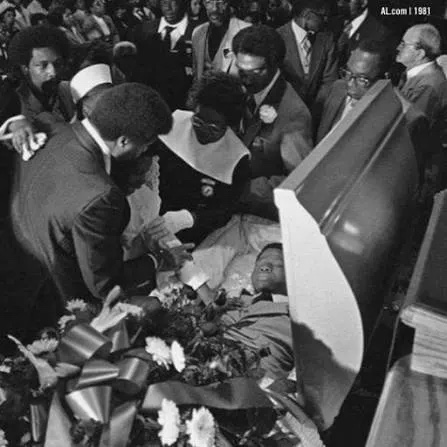
So, at the heart of this story are two things growing beneath the same Southern sun: a noose and honeysuckle. One teaches a little girl what the world is capable of doing to her, and the other teaches that the world does not get to decide what she is capable of becoming!

I’d love to know what stayed with you. Feel free to answer any of these prompts or write to me freely:
- What did the noose and the honeysuckle come to represent for you as you read?
- Was there a particular line or moment that made you pause? Why?
- And what do you make of Momma’s words: “There’s sweetness everywhere, baby. Even in the tangles.” Do you agree there are some places where sweetness can still be found without diminishing the pain that exists there?
Write to me and share how you experienced the story. Thanks for being here with me.
— Isis Bradford
Did this one delight you? Tap the heart.
Did this one stay with you? I’d love to hear what you think.
Join the conversation (3 thoughts)


3 thoughts on “Nectar & Noose”
Thank you for reading! I’d love to hear your thoughts.
To answer the last the question that I think ties into the first, yes it is possible, but I think it’s learning to hold the tension between tangles (pain) and sweetness that’s difficult.
I agree. it’s difficult, especially when the tangles are full of pain and thorns. When I learned about Michael Donald — the real life Mason Dudley — no nectar wiped away that pain! It took weeks to make sense of it. Thank you for sharing your thoughts, I appreciate it more than you know as I begin to share more of my writing and stories!